Friday, July 24, 2020

Story of an Ajad Hind Fauj (Indian National Army) fighter, who fought for and against British Army for six long years

My Nanaji, (Kunwar) Kashmir Singh Sen joined the Army not because he was looking for a job, but because he strongly believed joining the Army was the best way to help people in distress. As a descent from Suket royal family, he had acres and acres of land in the most fertile area, Bahl in Sundar Nagar. He also had a palatial house to live in the Suket princely state now called Sunder Nagar in Himachal Pradesh. As a child, he had no dearth of money yet be believed in giving part of his pocket money to his fellow poor children.

After his marriage with Krishna Devi Chandel, He was spending most of his time looking after his ‘Jamindari’ and two beautiful children. It was in late 1930es when the Second World War broke and the British Army started a recruitment drive in a princely state that he joined Dogra regiment the British army. After one year of training, he was tasked to fight in Singapore on behalf of the British Army.

His first assignment was in Singapore from where he was temporarily shifted to Miami beach after the Japanese attack on Pearl harbour attack in December 1941. He was probably carrying secret information from one post to another by crossing two dangerous rivers there, his son recalled. Nanaji used to recall how he carrying secret information of British Army with its alley US forces near Penang, which had just joined the Second World War II.

But that was for a very small period. He returned back to Singapore where his battalion had a fierce battle with Japanese forces in Raffles square area. His battalion suffered heavy casualties, more than 300 soldiers died and double of them sustained injuries. Finally, in February 1942, his battalion surrendered unconditionally to Japanese.

“The disposing off dead soldiers was a big problem for British as well as for Japanese forces… they ultimately dropped them in the ocean… among them were my friends, my juniors, my seniors and enemies from the Japanese army…I learn a hard lesson of my life that there is no enemy or friend after death… it changed my entire course of life…Suddenly I became much more mature,” He used to tell us while narrating his horrifying tales of Singapore war.

His pet dialogue was that an experienced soldier is not the one who carries maximum ammunition, but the one who carries maximum bhuna channe (fried grams) in his pocket. Nanaji always told us that “In a war, it is not the bullet that kills you… but it is hunger which demoralizes.….He had enough bullets but no water or food in the jungles of Singapore….. one by one he and his colleague used to go to jungle.. if lucky they would get some fruits or otherwise they used to eat sweet leaves, natural gums and sometimes even barks from trees and herbs..Drinking water was a big problem..He used collected water from the small stream and store it”. And that is why for the rest of his life he never tolerated wastage of food and water, says his daughter Surjeet Singh Rana. “My father used to tell us jokingly that anyone who would leave food in his plate would be sent to Singapore jungles for a month,” Surjeet recalls.

After the fall of Singapore, he along with 45,000 POWs was sent to POW Camp in Singapore mainly Bidadari. His stay as POW was brief and painful. His eldest son Shamsher Sing Sen, who retired as a revenue officer in the Himachal Government, remembers what his father told him about POW camps. “The food he was given was worse than what we used to sever our cattle. He also suspected that that Japanese probably added some chemicals in their food which caused him permanent stomach pain…After the Singapore imprisonment, he developed stomach pain.. that lasted all his life and ultimately became of the cause of his untimely death in 1985,” his son said.

In Singapore POWs camp, he became very weak due to unhygienic foods and water, many died due to dysentery, malaria, and cholera. It was finally when all POWs adopted the Bidadari resolution and set up the Indian Independence League, he got a chance to serve his motherland.

Nanaji told us his role in the Azad Hind Fauz. He recalled that his job was to distribute the copies of the resolution to soldiers, convince them to join Indian National Army (Azad Hind Fauz) —an armed unit the Indian Independence League, lead by Ras Bihari Bose, and prepare them to get ready for another war… this time with the British Army for India’s independence.

Now they would be using Japanese arms to fight British Army…All the soldiers were given a brief training to use Japanese arms and canons, which slightly different from the British armoury. But then there was a lull for months as the top brass of Azad Hind Fauz could not decide its strategy. It was only after Netaji Subash Chandra Bose took rein of the Indian Independence League in 1943 that Azad Hind Fauz again reenergized itself.

Nanaji recalled the impact of Netaji on the Azad hind Fauz. “Even the local youth started joining INA and we were again busy in giving a crash course to locals to fight against British”. “Some of us were also given the training to fly fighter pilots at Japan’s Imperial Military Academy, and the stage was set for the final battle”.

 He used to get emotional when he remembered his last battle “Chalo Delhi” (March to Delhi). “We all were physically weak due to month-long starvation like situation, but when we fought against the British, we ourselves were amazed at our performance…. Probably because we were fighting for the independence of our country…. Imagine some times were fighting with a ‘bottle of petrol’ (petrol bump) to defeat a British Tank…Though we lost the battle…. But now I can proudly say we did our best,” He told us. He was ultimately captured near Akaran in Burma and imprisoned in Rangoon Jail and later released after independence in 1947.

At home, life was very tough for his wife Krishna Devi. She did not see Nanaji for nine long years and after 1941 was not sure whether he was alive. His eldest son Shamser Singh Sen says there was no communication except a few letters before 1941, people had presumed that he sacrificed his life in the World War-II. He said “In 1947 we were surprised to see him back. He, along with INA jawans, was released at Ner Chowk.. 15 Kilometers from his home,” Shamsher Singh said.

“If you ask me to sum up his personality… I would say he was a great man. He never sided with wrong and told us if you do anything wrong I would be the first person to punish you… and he applied it in letter and spirit throughout his life. He never spared anyone who was wrong whether he was his senior or his child,” his daughter Surjeet Singh Rana says.

When the government asked landlords to donate the tilling land to agriculture labourer, he was the first person to do so happily. “The acres and acres of land in Bahl, which today is to the tune of several hundred crores, was donated to tilling labourers…And since he was left with little money and land, he had to work as a casual labourer to make roads. And later a Chowkidar in Bhakra Beas project in Sundar Nagar, part of which was built on his land,” said his son-in-law K R Thakur, an expert in International affairs, who worked as an editor in Soviet Information Centre.

My Nanaji never regretted that he donated his land or worked as a casual labourer… in fact, he never claimed freedom fighter pension till 1971 when his brother-in-law, Raja Virbhadra Singh, who was then Member of Parliament. Ultimately he reluctantly accepted the pension from the centre and state government as well as Tamra Patra from then Prime Minister Indira Gandhi.

Later when Virbhadra Singh became the Chief Minister of Himachal Pradesh he asked him to avail several benefits but he always refused it politely. “What I have done… it was my duty and I tried to put in my best,” he used to tell his children whenever they insist on taking favours from the government.

Ends.

Thursday, July 23, 2020

India to revive its dying fertilizer units to make India self-reliant in the fertilizer sector.


India to revive its fertilizer industry
With a view to become self-reliant in urea production, the centre has taken a series of initiatives to boost  Indian fertilizer sector so as to make it available to the farmers during the sowing season.

Government has taken a major decision to infuse Rs 900 crore in Fertilizers and Chemicals Travancore Ltd (FACT)) for its modernization, said the Union Minister of Chemicals and Fertilizers DV Sadananda Gowda.

He said the centre has taken various initiatives to boost fertilizer sector so that an adequate amount of fertilizers could be made available to farmers during the sowing season.

India to revive its fertilizer industry
The Minister said under the provisions of New Investment Policy – 2012 and its amendment in 2014, Chambal Fertilizers & Chemicals Limited (CFCL) has set up a Brownfield project at Gadepan, Rajasthan with a production capacity of 12.7 LMT Urea per annum. Here the commercial production started on 1 January 2019, which helped in producing  244.55 LMT indigenous urea in the country during 2019-20.

Government has started reviving the closed fertilizer units of various PSUs including the FCIL at Ramagundam, Talcher, Gorakhpur & Sindri and HFCL unit at  Barauni. This is a Joint Venture of nominated PSUs to set up gas-based fertilizer plants of 1.27 MMTPA capacity each.

Half a dozen fertilizers projects would be commissioned in the coming three years. While Ramagundam project is already under the pre-commissioning stage, three projects including Gorakhpur, Sindri, and Barauni would be commissioned next year, the Minister said.


Source Ministry of chemicals and Fertilizer
The Indian Fertilizers Market is expected to witness a CAGR of 11.9% during the forecast period 2020-2025.

India is the second-largest consumer of fertilizers in the world with an annual consumption of more than 55 million metric tons. Among the various type of fertilizers used in India, Urea is one of the highest consumed fertilizers in the country as a source of Nitrogen. The consumption of Urea in the country as of March 2018 was 29 million tons. DAP is the second majorly consumed fertilizer in the country.

According to the Department of Fertilizers, the total production of Urea in India was 20.7 million metric tons in 2017 and DAP was 14.6 million metric tons in 2017, which was 1.36% higher compared to the previous year.

Fertilizer Situation in India

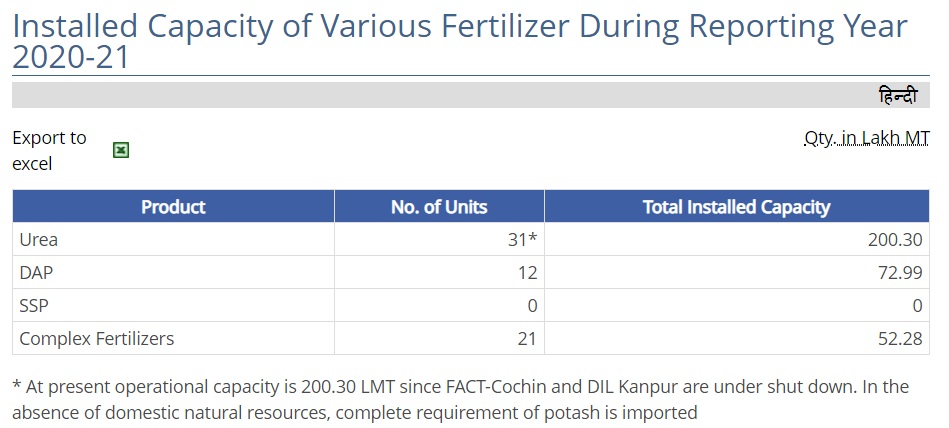
India today is the third-largest producer of nitrogenous fertilizers in the world only behind China and USA. At present, there are 30 large size units in the country producing urea (as on date 29 are functioning) 21 units produce DAP and complex fertilizers, 5 units produce low analysis straight nitrogenous fertilizers. Besides, there are about 80 small and medium scale units in operation producing single super phosphate (SSP). The total installed capacity of fertilizer production, which was 119.60 LMT of nitrogen and 53.60 LMT of phosphate as on 31.03.2004, has marginally increased to 120.61 LMT of nitrogen and 56.59 LMT of phosphate as on 31.03.2011.


Fertilizer Requirement in India and its forecast.

According to the Department of Agriculture, Cooperation & Farmers Welfare, agriculture production in the country has increased despite the decreasing are under cultivation. The production of rice has reached 110.15 million metric ton in 2017 and wheat production has reached 98.38 million metric ton from 104.41 million metric ton of rice and 92.29 million metric ton of wheat in 2016. Various Initiatives of Government of India, such as Initiative for pulses by providing subsidy fo quality seeds produced, cluster frontline demonstrations through KVKs and so on are also being undertaken under National Food Securit Mission (NFSM) for increasing the production and productivity of pulses in the country.


Sonu Sood on another heroic mission, this time to generate employment after lockdown

After earning a position in the heart of migratory workers, whom he and his team helped tirelessly during Lockdown, ‘One of the Best Villains in Bollywood industry” Sonu Sood, has announced to start another mission “अब है रोजगार की बारी”, means he would now generate work.

In his tweet posted late last night, the Cine star did not mention the roadmap to generating employment. However, considering the ‘selfless and tireless work’, it would not be difficult for him to devise a strategy.

One would not be surprised if many people, NGO and organizations would come to his help with monetarily and otherwise. Let’s see how his noble cause goes ahead.


His contribution during Lockdown:

In May 2020, during the nationwide lockdown due to the COVID-19 pandemic, he helped thousands of stranded distressed poor migrant workers (who hardly had anything to eat or any place to stay) to reach their homes from mainly Mumbai by arranging buses, special trains and in a few cases chartered flights.

1973 born Sonu Sood first came into limelight from his character Chedi Lal and attracted interest in the Bollywood Industry. Earlier he had acted predominantly in Hindi, Telugu, Tamil, Kannada and Punjabi films.

But he actually hit the headline after he started helping people in distress during the lockdown. During the lockdown, he was easily accessible, reacted to people’s tweet, comfort them, and his team made sure that all those whom he helped were treated “honourably”.

In after this, he became a real-life hero. The kind of appreciation he earned in the past two months, he had not earned that during his more than two-decade of an acting career. He came to Bollywood in the late nineties to get an acting assignment, but when he did not get a break he shifted to Tollywood. Today he is an action, producer, and owns a production house 'Shakti Sagar Productions' after his father's name.

His mass press was felt from his character Chedi Lal in Dabang movie. He not became famous among the public but also attracted interest in the Bollywood Industry. Earlier he had acted predominantly in Hindi, Telugu, Tamil, Kannada and Punjabi films.

He because a household name in Bihar and Uttar Pradesh after he started helping people in distress during the lockdown. During the lockdown, he was easily accessible, reacted to people’s tweet, comfort them, and his team made sure that all those whom he helped were treated “honourably”.

He won the hearts of millions of people and today his followers are over 2.4 million, most of which increased during Lockdown. It is still increasing continuously

After completing his education in nineties, he came to Bollywood for an acting assignment, but could not find a place and later got a break in 1999 in a Tamil language film with Kallazhagar and Nenjinile.

 He then appeared as an antagonist in the Telugu film Hands Up! in 2000. In 2001, he appeared in Majunu.

He then began starring in Hindi films, with Shaheed-E-Azam, as Bhagat Singh in 2002. Sood earned recognition as Abhishek Bachchan's brother in Mani Ratnam's Yuva in 2004 and in Aashiq Banaya Aapne in 2005.

In Tollywood, with the release of Super in 2005, he received greater recognition for his work. In 2009, he played the role of Pasupathy in Arundhati. Following the Tollywood release of Arundhati, he played the role of Rajkumar Sujamal in the Indian epic film Jodha Akbar, directed by Ashutosh Gowariker.

In 2009, he received the Andhra Pradesh State Nandi Award for Best Villain and the Filmfare Award for Best Supporting Actor – Telugu for his work in the Telugu blockbuster Arundhati. In 2010, he garnered the Apsara Award for Best Actor in a Negative Role and the IIFA Award for Best Performance in a Negative Role for the Bollywood blockbuster Dabangg.

In July 2016, he established the production house Shakti Sagar Productions, which is named after his father, Shakti Sagar Sood.

Ends.


Wednesday, July 22, 2020

Despite COVID-19, No scarcity of fertilizers in India. Sale up substantially... an indication of good Kharif crop this year.

If the sale of fertilizer in India is any indication, the Kharif the crop will have no impact of COVID-19 pandemic, rather production may register an increase than last year.

Releasing the production and sale date, the Union Minister of Chemicals and Fertilizer D V Sadananda Gowda said despite the spread of COVID 19 pandemic, production and movement of fertilizers remain comfortable across the country. He assured that there would not be any scarcity of fertilizers in any part of the country.

He said from April to June 2020, total fertilizers production touched 101.15 LMT (Lakh Metric Tonnes) which is 2.79% higher than the last year.  According to the Data published by the Fertilizer Ministry, sale of urea had increased by 5.29 %, DAP by 15.67 %, MOP increase by 3.45 %, and PNKS by 9.95 % in 2019-20 with respect to 2018-19.  “Production and movement of fertilizers are satisfactory all over the country with respect to last year," the Minister said.

Similarly, Urea production during the same period touched 60.38 LMT which is 8.40% higher than the corresponding period of last year, he said. Last year, The situation was also comfortable across the country and there was a record high urea production of 244.55 LMT as compared to 240 LMT during 2018-19.

Even the total sale of Urea had also increased in 2019-20 to LMT as compared to 320.20 LMT of the previous year fiscal year, 2018-19.  He added that from April to June 2020, total fertilizers production touched 101.15 LMT which is 2.79% higher than the corresponding period of last year. Urea production during the same period touch 60.38 LMT which is 8.40% higher than the corresponding period of last year.

The consumption of fertilizers had also seen a considerable jump compared in 2020 compared to last year. In the Rabi this year, Urea consumption increased by 10.64%, DAP increase by 31.65%, MOP increase by 25.41%, NPKS increase by 28.81%.

ends.